

 By Victoria Plum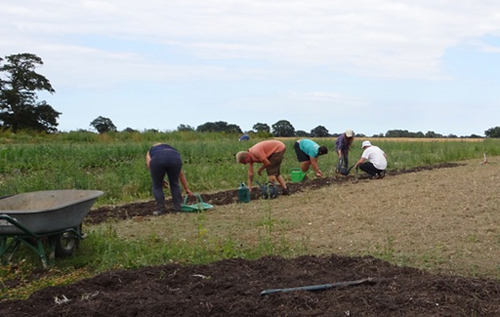
By Victoria Plum
I’m thinking about dry conditions. You probably are, too.
When I lived on a Greek island I planted orange and olive trees where the soil was very poor and conditions generally very dry. Once established these trees would thrive – but getting them established was difficult.
So I planted the trees as deep as possible with as much water as possible, filled the hole with soil, about three quarters full, and then laid a square of plastic sheeting horizontally, about 18 inches square, with some holes in it around the tree and then filled the hole with the remaining soil. I left the soil a little lower around the tree with a small soil barrier to secure water where I wanted it.
The holes in the plastic allow water through to the roots below, but the sheet stops excess water loss. The heat of the sun causes condensation on the underside of the plastic layer, so moisture then drops back down to the roots rather than evaporate into the air above.
The wild mountain garrigue there, of thyme, sage and the wire-netting bush, grows from only a few inches high to perhaps two feet, so you might think these plants are young.
However, when dynamite blasting of the rock has been done (to create flat areas for building) you can see the exposed roots of such small plants actually go down through fissures in the rock perhaps 20 feet in search of water and sustenance.
So they are old, perhaps hundreds of years, and will cope with any drought. Perennial plants usually cope with drought better than annuals, and research is being done on the viability of perennial corn crops. What a shock to an English farmer’s system that would be!
In my garden here I only water plants newly established this season and when the butts are empty I use a hose, but only trickling very slowly at ground level to soak the ground because I don’t want to compact the soil by pounding water onto it.
A traditional gardeners’ saying is “a hoeing is as good as a watering”, which just emphasises that air is as important to plants as water.
And soil quality is crucial. I was at the Eves Hill community market garden (pictured above) for two days (mid-July) and there, on soil essentially pitifully poor and impacted, the constant and liberal application of green waste, courtesy of Broadland District Council and keen volunteers, opens the soil for root growth and helps to hold water where the plants need it, so that in this difficult season growth and plant health is surprisingly good.
Photo: Tina Sutton
 Geoff Fisher