

 By Victoria Plum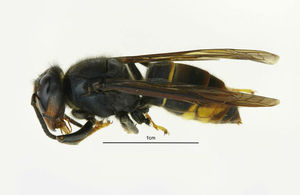
By Victoria Plum
They used to say that a hornet sting could kill a horse. I don’t think this is true, although of course you wouldn’t want to be stung by anything if you could avoid it.
It is true, however, that several stings can be extremely dangerous, but here is a further danger alert, and it concerns the invasive Asian hornet, Vespa velutina.
Already found in France and Spain, and now spreading far and wide, it is essential that we keep our eyes open because this foreign invader has a voracious and indiscriminate appetite for our bees and many of our beneficial insects.
Some have been caught and eradicated in this country, spotted initially by gardeners (we must be as observant lot!).
Search online and report sightings to alertnonnative@ceh.ac.uk. Please notify; do not kill the hornets, as experts will come and seek out the nest and destroy it, which is, if you think about it, the best strategy.
Asian hornets are slightly smaller than our natives – and noticeable because they look dark. They have a black abdomen (only the fourth segment is yellow) and yellow legs, whereas our natives look more wasp-like with mostly a yellow abdomen and dark legs.
Reepham & District Gardening Club member Alvan Parker told us about this current threat to his beloved bees. What would we do without bees and without honey?
The talk for January at the gardening club was by Tamara Bridge, and focused on her gardening career, design business and how she was led to the exciting challenge of creating several sponsored show gardens for Chelsea.
Her charm and enthusiasm carried us all along as she explained how time and again she made the impossible happen. She clearly relishes thinking all round a problem and bringing together experts who pool their resources to make a really creative team.
I have very little interest in Chelsea show gardens, but I found Tamara’s story inspiring – and myself wishing I had the energy to start a new career.
Next month, Reepham & District Gardening Club will have Dr Carl Sayer of University College London to talk about the restoration of ponds and lakes in Norfolk. This will be held on Tuesday 18 February at 7.45 pm in Reepham Town Hall, Church Street, Reepham.
Image: Defra
 Geoff Fisher